See everything your business has written, on one map.

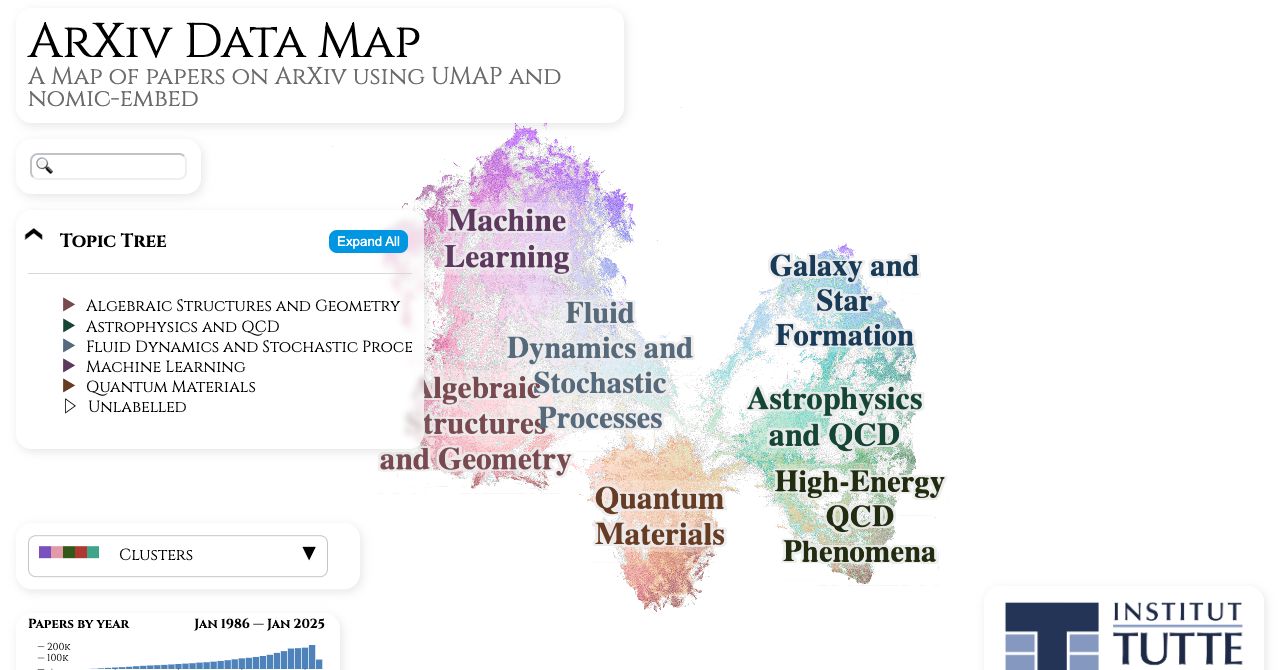
/datamap is a Claude skill for small business owners. Point Claude at your reviews, your notes or your website. A few minutes later you have a map you can explore, and a partner to explore it with.

Runs on your computerNo code neededBuilt on Tutte Institute maths
/datamap my KnowledgeForge repo. What do I actually know?
  • Read 587 notes from the repo
  • Tidied them into one OKF bundle
  • Mapped them on this computer
  • Named 18 regions

587 notes in 18 regions. The biggest, SEO and content craft (65 notes), is know-how you could sell to clients. And 88 notes are the same instructions copied for each AI tool. Open the map ↓

One command. A map, then a conversation.

Type /datamap and say what to map. Claude does the rest, and then stays with you to work out what the map means for your business.

01 · Ask

Say what to map

A reviews or survey export, a folder of notes, your inbox, or your website.

02 · Gather

Claude reads it

It reads pages and files itself and tidies them into clean notes (Open Knowledge Format), fixing what AI tools can't read.

03 · Map

Similar things land together

On your computer, every note becomes a dot; dots about the same thing form regions.

04 · Talk

Ask what it means

Claude names every region in plain words, writes a short report, and answers your questions by pointing at the map.

The mapping is a "King Tutte pipeline": UMAP, HDBSCAN and DataMapPlot, open-source tools from the Tutte Institute for Mathematics and Computing.

Showcase · a second brain

Internexio, a one-person software studio

A solo consultant maps 587 notes of hard-won know-how, finds what to sell, and sees what to clean up.

587notes
18regions
1person's know-how
Owner
/datamap my KnowledgeForge repo. What do I actually know?
Claude
  • Read 587 notes from the repo
  • Tidied them into one OKF bundle
  • Mapped them on this computer
  • Named 18 regions

The biggest region is 65: your marketing and search know-how. Next come 63 and 37, which document the product itself, and 35.

173 notes don't fit any one region; they're the grey dots.

Owner
Which of this could I sell to small-business clients?
Claude

Start with . Its 65 notes cover ad-performance checks, Search Console fixes, marketing copy without the tell-tale signs of AI, and rules for founder posts. That's a "search and content" package small businesses already pay for.

Your agent regions, like 18 and 12, are a second offer: a workshop for technical founders.

Owner
Anything I should clean up first?
Claude

Two things:

  1. One copy per instruction. 88 notes are the same instructions repeated for each AI tool. They're spread over 9 regions, 26 of them in , which makes your product docs look bigger than they are. Map one copy next time.
  2. Date your notes. 194 have no date, so the map can't show when you learned them. I can add dates from the git history.

Example conversation, built on the real map of the open-source KnowledgeForge repo (Apache-2.0, David Pedersen). Every number above comes from it.

Scroll to zoom · hover a dot to read the note · click it to open · Full screen
Showcase · a website

thinkspace, coworking in Seattle and Redmond

The owner asks what 18 years of their own website say. The map answers in one picture, and the conversation turns it into a content plan.

629pages read
23regions
2008–2026years covered
Owner
/datamap thinkspace.com. What does our website actually say about us?
Claude
  • Read 629 pages from thinkspace.com
  • Saved each page as a note and tidied them
  • Mapped them on this computer
  • Named 23 regions

The biggest regions are 60, 52 and 39.

The Over time chart in the corner tells the bigger story: 459 pages are from 2008–2013, and 2011 alone has 152. Since 2021 there are 16 new pages, and 13 of them are .

Owner
Our homepage says "Deeply human. AI-native." Does the rest of the site back that up?
Claude

Barely. Find on the map: 8 of 629 pages mention it. Six are the homepage and your offer pages (virtual offices, event space, staff). Only two are blog posts: a 2013 book review and "21 Questions to Ask Yourself Before You Try and Sell Your Company" (2026).

Green living, meanwhile, fills three whole regions: 23, 19 and 18. 42 of those 60 pages are from 2008. A visitor who reads past the homepage meets the thinkspace of 2008–2013.

Owner
What should we do about it this month?
Claude

Three things, in this order:

  1. Fill the empty space. Write the posts the map can't find today: how members use AI day to day, a spotlight on an AI startup in the space, and a recap of today's Claude hackathon.
  2. Bring back member stories. 17 stopped in 2019, and 11 in 2016. They're the most human part of the site.
  3. Give 2008 a home. Move the green-living posts to an "Our history" page, so new visitors land on today's thinkspace.

Want me to draft the hackathon recap first?

Example conversation, built on the real map. Every number above comes from it. Click a highlighted region or search to see it on the map.

Scroll to zoom · hover a dot to read the page · click it to open · Full screen
Showcase · a team handbook

Sourcegraph's company handbook

An operations lead maps 835 handbook pages to fix onboarding. The same works for a ten-person team's SOPs and policies.

835pages
20regions
85%in team folders
Ops lead
/datamap our handbook. New hires keep saying they can't find anything.
Claude
  • Read 835 handbook pages
  • Tidied them into one OKF bundle
  • Mapped them on this computer
  • Named 20 regions

Here's why. 709 of the 835 pages (85%) sit inside team folders: engineering alone has 175, support 120 and security 85. Only 58 pages explain how the company works as a whole.

The biggest region, 179, is written for engineers on call, not for someone in their first week.

Ops lead
What should a new support engineer read in week one?
Claude

There are 38 guides, and 22 of them already sit together in . For support, read those first, then and .

I can turn those three regions into one week-one reading list, in order.

Ops lead
What's cluttering it?
Claude
  1. Machine-made pages. Security-scan records fill two whole regions, 32 and 15, and another 21 pages are . Engineers need them; new hires keep landing on them. Move them out of the main handbook search.
  2. Orphans. 104 pages fit no region (the grey dots). They're often outdated or misfiled; I can list them for an owner to review.

Example conversation, built on the real map of Sourcegraph's public handbook (GitHub, Apache-2.0). Every number above comes from it.

Scroll to zoom · hover a dot to read the page · click it to open · Full screen

Map your own business

Anything with words in it works. Most tools already have an "Export to CSV" button.

Reviews & surveysGoogle, Yelp, Shopify or Typeform exports. Ratings and dates are used automatically.
Notes & wikisAn Obsidian vault, a folder of Markdown, a "second brain", an OKF bundle.
Your websiteClaude reads the pages itself. Each dot links back to the live page.
DocumentsA folder of PDFs or text files: proposals, reports, meeting notes.

Set up once

  1. Get Claude Code, in the Claude desktop app or the terminal. Any paid Claude plan works.
  2. Ask Claude: "Install the /datamap skill from github.com/Connoiter/claude_for_small_businesses_hackathon". It downloads the project and sets everything up. No ZIP, no code.
  3. Type /datamap in any folder and say what to map.

Mapping runs on your computer. Claude reads short samples from each region to name it.

# Once: ask Claude to install it
Install the /datamap skill from https://github.com/Connoiter/claude_for_small_businesses_hackathon

# Then, in any folder
/datamap reviews.csv
/datamap ~/Notes/my-vault
/datamap https://yourbusiness.com

# Or ask in plain words
What are my customers saying in reviews.csv?